Both people sign. Neither signature can be forged by us.
What happens in the four seconds when goods actually change hands on a quay — and why the record that comes out of it settles the argument three weeks later.
- WhatThe delivery, bound to one job and the amount committed to it.
- WhoNamed people on both sides, each identified by their own device.
- WhenStamped on the quay, not back at the office hours later.
- Written onceA correction adds a line. Nothing is overwritten.
Thirteen screens, in the order they happen.
Captured from the current build at phone width, one role at a time, on the seed vessel. Swipe along the strip. The two-phone exchange with no signal, described further down, is still in build and is not shown here.
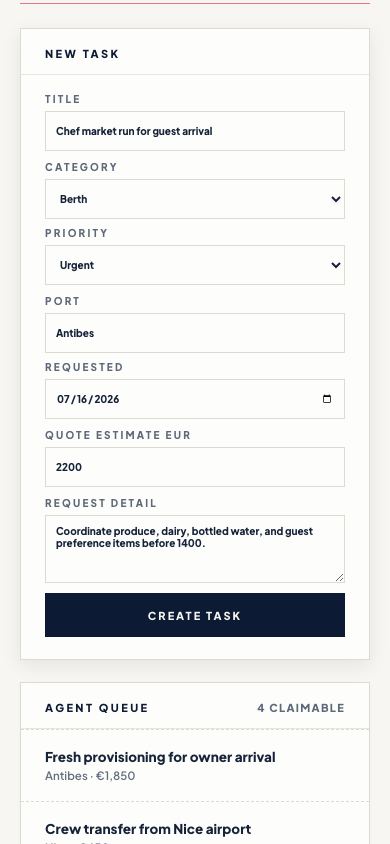
01Head of department requests 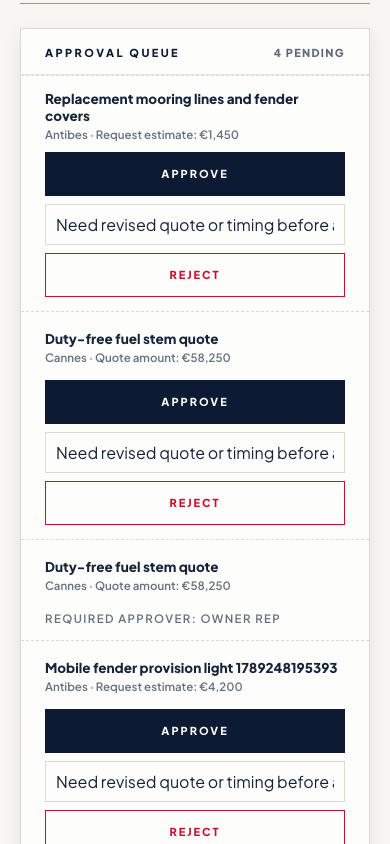
02Captain approves the request 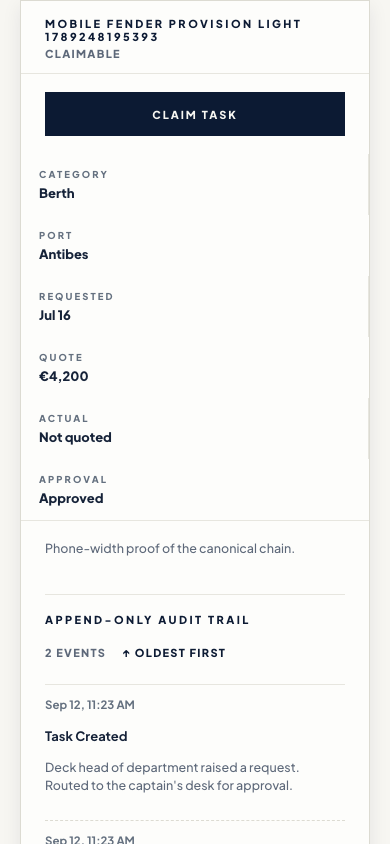
03Agent takes the job 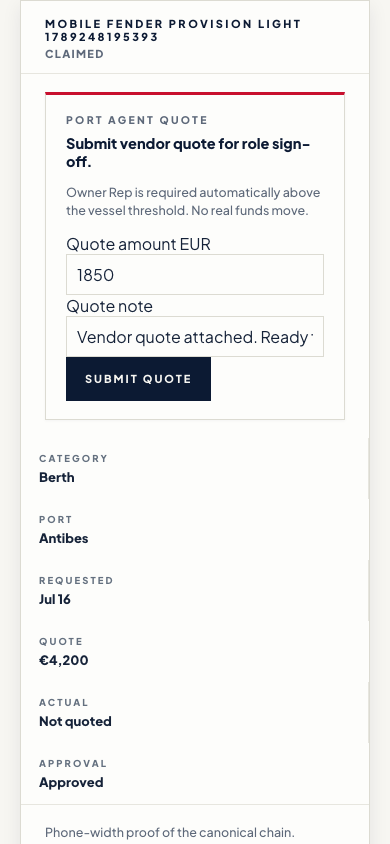
04Agent quotes 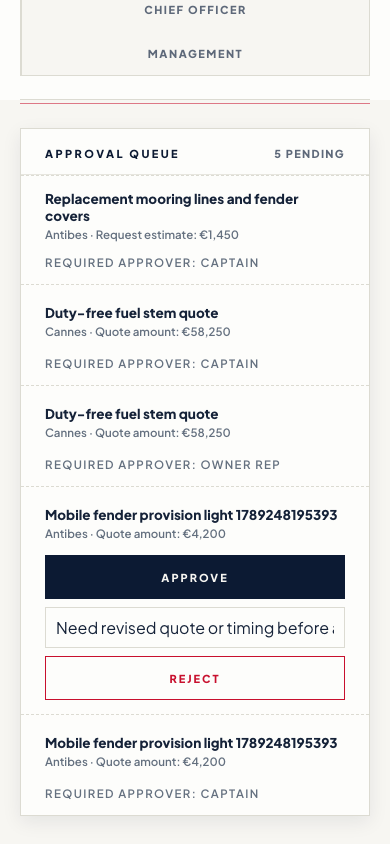
05Head of department approves the quote 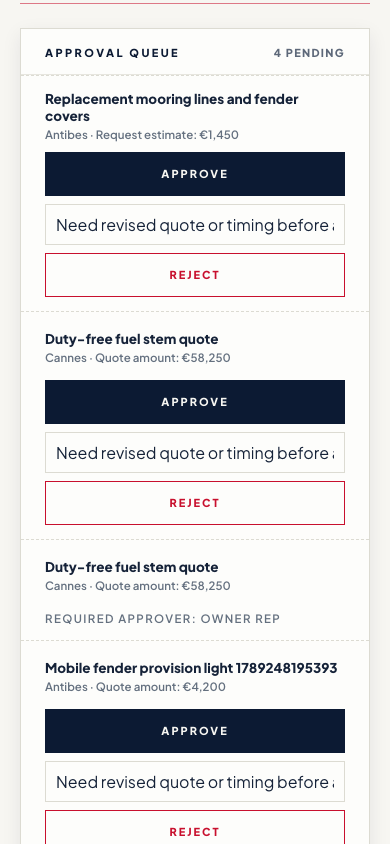
06Captain approves the quote 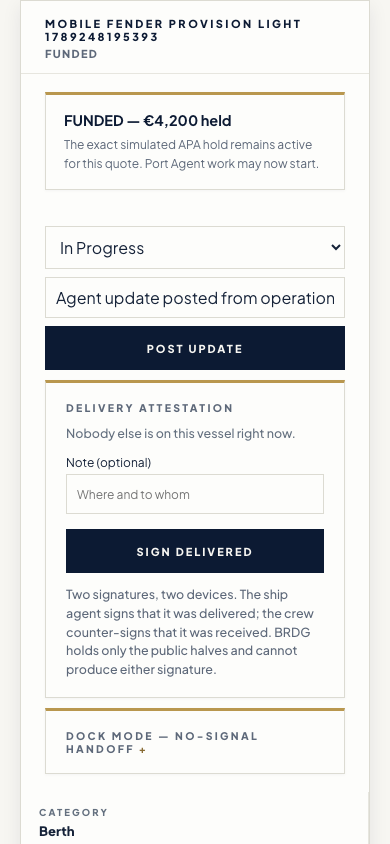
07Funds held 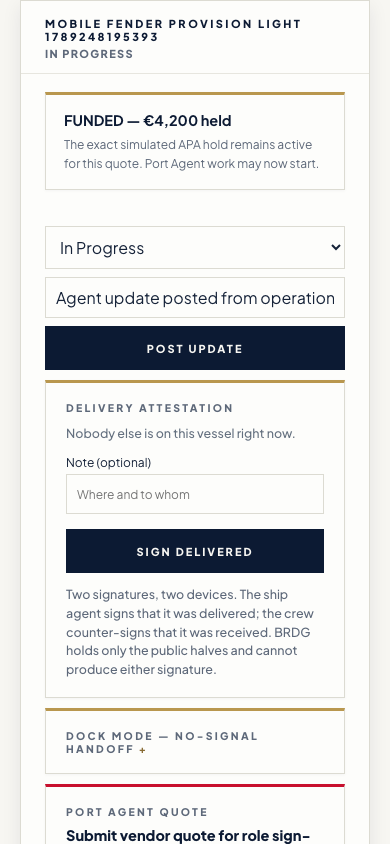
08Agent signs delivered 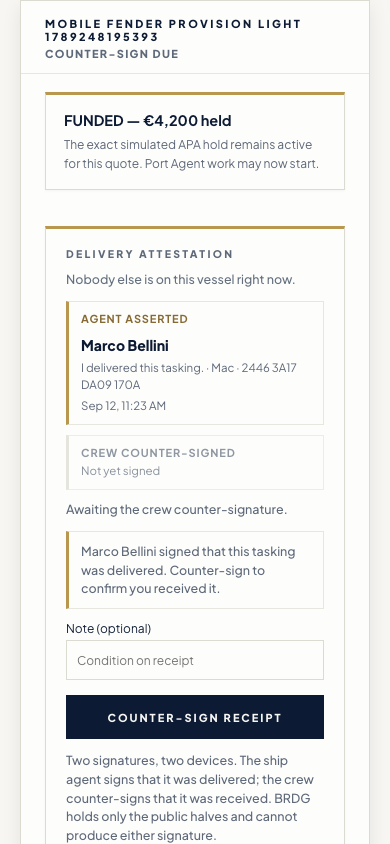
09Crew counter-signs 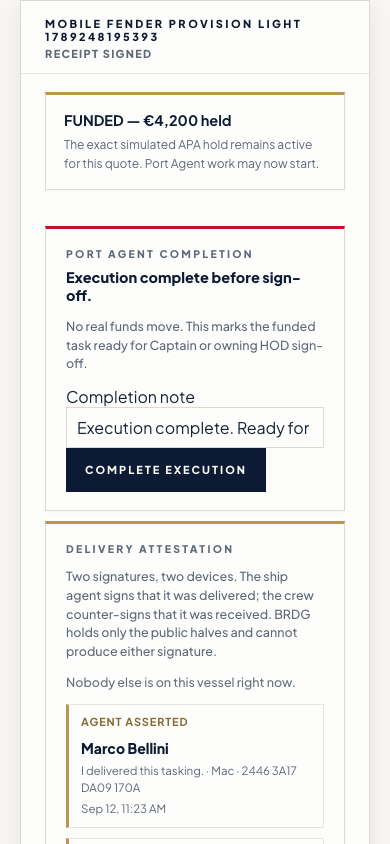
10Work marked complete 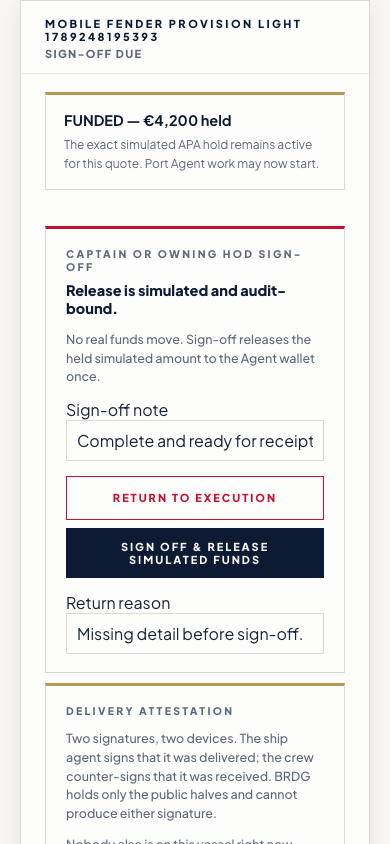
11Captain signs off 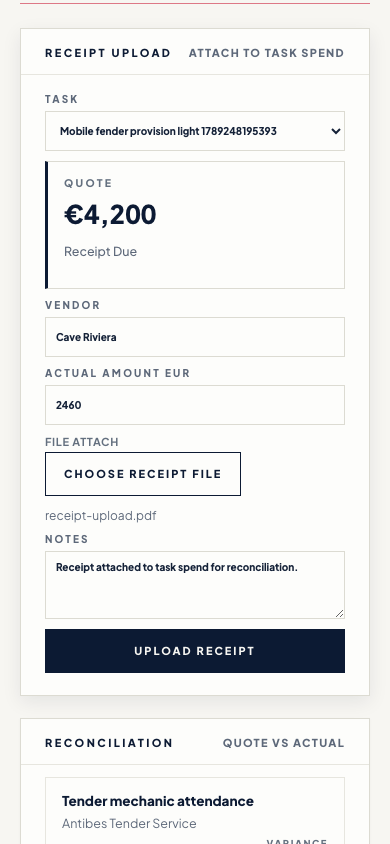
12Receipt filed 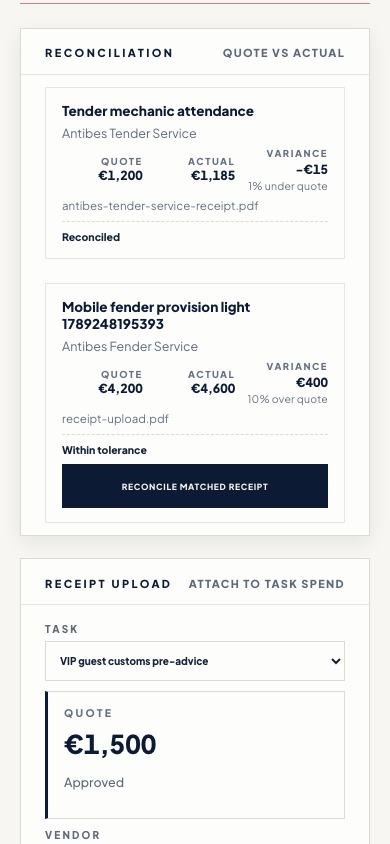
13Receipt reconciled


Forty crates land on the quay at 06:40. Three weeks later, six of them are disputed.
A deckhand who happened to be on deck signs a paper docket. Nobody photographs anything. The chef is asleep. Later the galley says part of the order was the wrong grade and should never have been accepted, the management company queries the line, and the invoice goes into the drawer marked we will sort it out at the end of the season.
The agent has one signature, in biro, from someone whose name they cannot read, on a page in a folder. They cannot show what was handed over, or when, or that anybody on the vessel agreed at the time. So they eat it, or they spend a week of their life arguing about fish.
The agent marks the job delivered on their phone. A code appears on the screen. It lists what is being handed over, against which job, and the amount that was committed to it.
The crew member scans that code with their own phone and reads it back. They see the same thing the agent sees before they agree to anything. If it is wrong, this is the moment it gets said.
They accept, and their phone signs. The signature is made by a key that was created on that phone when they were set up, and has never left it.
A second code goes back to the agent, and the agent's phone signs too. Now both phones hold the same record, carrying both marks.
Neither of them needed a bar of signal for any of it. When either phone next finds a connection, the copies sync and are checked against each other. If they ever disagreed, that would be visible.
We built ourselves out of the position to fake it.
Every phone makes its own signing key the first time its owner is set up. That key stays on the phone. It is never sent to us, we never store it, and we could not read it if we tried.
The blunt consequence: BRDG cannot produce your signature. Not by accident, not to keep a large client happy, not under pressure from a vessel or a management company, and not if somebody breaks into our systems. The same is true in the other direction — the vessel cannot manufacture yours, and you cannot manufacture theirs.
Only your phone can make your mark. Only theirs can make theirs. If a handover carries both, both people were standing there when it happened. That is the whole idea, and everything else on this page is plumbing.
A record neither side can quietly change later.
What, and against which job
The handover is bound to one specific job and the amount committed to it, so it cannot be lifted and reused against a different line.
Who, on both sides
Named people, not roles. The agent who handed over, and the crew member who took delivery — each identified by their own device.
When it actually happened
Stamped at the moment of the handover on the dock, not at the moment somebody remembered to type it up back at the office.
Written once
Corrections are added as a further line, in the open. Nothing is overwritten, so the story of a disputed delivery reads in order rather than arriving already tidied up.
What this is not.
It is not a legal signature service, and it does not replace your agency agreement, the ship's papers, or a customs declaration. It does not decide who is right in a dispute.
It is a record of what two people agreed had happened, made at the moment it happened, that neither of them — and neither of us — can change afterwards without it showing.
The record underneath: intake, execution, captain sign-off, receipts, reconciliation, and a log that is written once. It runs on the production schema, against a local data layer rather than a live database.
The two-phone signed handover described on this page, including the offline exchange. It is being built now for METSTRADE and is not finished.
No money movement of any kind. BRDG holds no funds, and no part of the handover transfers any.
Tell me where this breaks on your dock.
You have handed over more cargo on more quays than I have. If there is a moment in that sequence that does not survive contact with a real delivery, I want to hear it before November, not after.